Why Your Enphase Panel-Level Monitoring May Be Wrong — Even When Your Solar System Is Producing Normally
One of the more confusing solar service calls we encounter is when a homeowner opens their Enphase app and sees panels producing almost no energy — sometimes just “1 Wh” or “2 Wh” for the entire day — while the home and utility meter suggest the system is actually working.
At first glance, it looks like catastrophic panel or inverter failure.
But often, the issue is not production itself. It’s reporting.
Recently, we worked on a system in Hastings-on-Hudson, NY that perfectly illustrates this issue after squirrel damage forced replacement of several older Enphase M250 microinverters.
The Problem
The homeowner noticed that many modules in Enlighten appeared to be barely producing any energy.
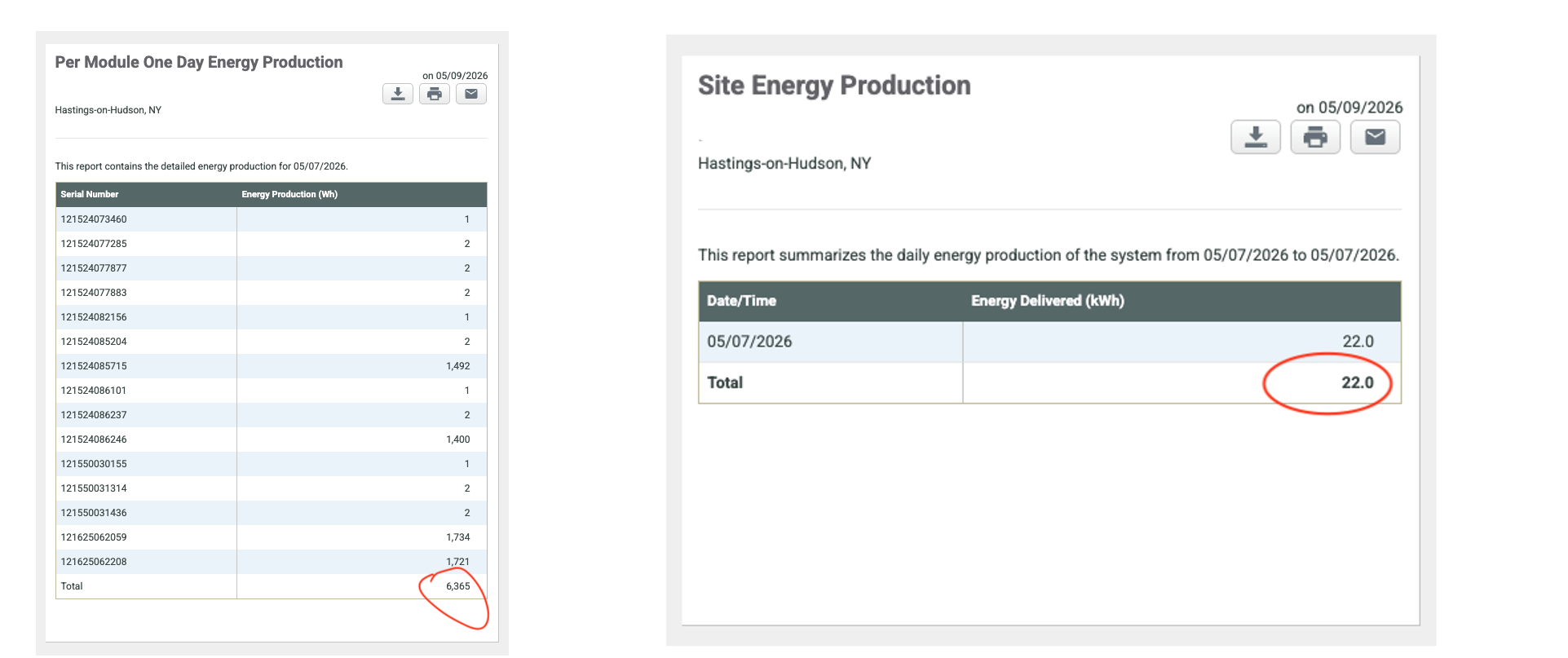
The panel-level production report showed numbers like:
-
1 Wh
-
2 Wh
-
1 Wh
…across multiple modules for an entire day.
At the same time, the system-level production report showed the array produced roughly:
-
22.0 kWh total system production
That immediately told us something important:
The solar system was almost certainly producing correctly.
The module-level reporting was not.
The Key Difference: Panel-Level Reporting vs. System-Level CT Monitoring
Older Enphase systems often have two separate ways of measuring production:
1. Module-Level Reporting
Each microinverter individually reports production data back to Enlighten.
2. Production CT Monitoring
A production CT (current transformer) installed in the combiner panel measures total system output directly.
Think of the production CT as the “master meter” for the system.
If the CT says the system produced 22 kWh, but the panel-level view only totals 6 kWh, the issue is usually communications or reporting — not actual solar production.
What Happened on This System
Several original Enphase M250 microinverters had been damaged by squirrels chewing through wiring beneath the array.
Because Enphase M250s are discontinued, we had to source replacement units from the secondary used market.
After installation:
-
The replacement microinverters eventually came online correctly
-
The new units began reporting accurately
-
Many of the remaining original M250s continued producing power
-
But several older units stopped reporting production correctly in Enlighten
This created a mismatch where:
-
Actual production was normal
-
But module-level data was incomplete or incorrect
Why Older Enphase M250 Systems Sometimes Report Incorrectly
We see this more frequently on aging M190/M215/M250-era systems.
Possible causes include:
-
Aging PLC communication hardware
-
Envoy communication instability
-
Firmware mismatches
-
Partial gateway sync issues
-
Older microinverters remaining operational electrically but losing clean communications
-
Mixed fleets of older and replacement used microinverters
-
Electrical noise on powerline communications
-
Damaged trunk cable sections from rodents
Importantly:
A microinverter can still produce power while failing to report accurately.
That distinction matters.
How We Diagnose the Difference
When troubleshooting these systems, we compare:
Panel-Level Production Totals
vs.
Production CT Totals
If the production CT aligns with expected weather and irradiance conditions, but the panel data does not, that points strongly toward a monitoring/reporting issue rather than a true production failure.
We also compare:
-
Utility net meter behavior
-
Historical production trends
-
Array orientation and shading
-
Individual inverter communications status
-
Real-time AC voltage readings
-
Enlighten device connectivity
Common Signs of a Reporting Problem (Not a Production Problem)
You may have a reporting issue if:
-
Panels show exactly 1–2 Wh repeatedly
-
Multiple panels fail simultaneously
-
Total system production still appears normal
-
Utility bills do not spike dramatically
-
Production CT values look reasonable
-
The system still exports power during sunny conditions
The Challenge With Discontinued Enphase Equipment
One growing issue in solar O&M is aging legacy equipment.
Many older Enphase microinverters are discontinued, including:
-
M190
-
M210
-
M215
-
M250
That forces homeowners and service providers into difficult decisions:
-
Source used replacements
-
Retrofit partial systems
-
Upgrade entire arrays
-
Maintain aging monitoring infrastructure
In many cases, the system can continue operating effectively even if monitoring becomes imperfect.
The Big Takeaway
Monitoring data is not always the same thing as actual production.
A solar system can produce normally while displaying incorrect panel-level information due to communication failures, especially on older Enphase systems.
That’s why experienced troubleshooting matters.
At Rivertown Solar, we regularly diagnose:
-
squirrel damage
-
legacy Enphase issues
-
monitoring discrepancies
-
production CT mismatches
-
abandoned solar systems
-
partial inverter fleet replacements
If your solar monitoring suddenly looks wrong, don’t assume the entire system has failed.
Sometimes the system is still doing exactly what it was designed to do — even if the app says otherwise.